Russia Cashes In on Middle East War While Its Own Economy Fractures
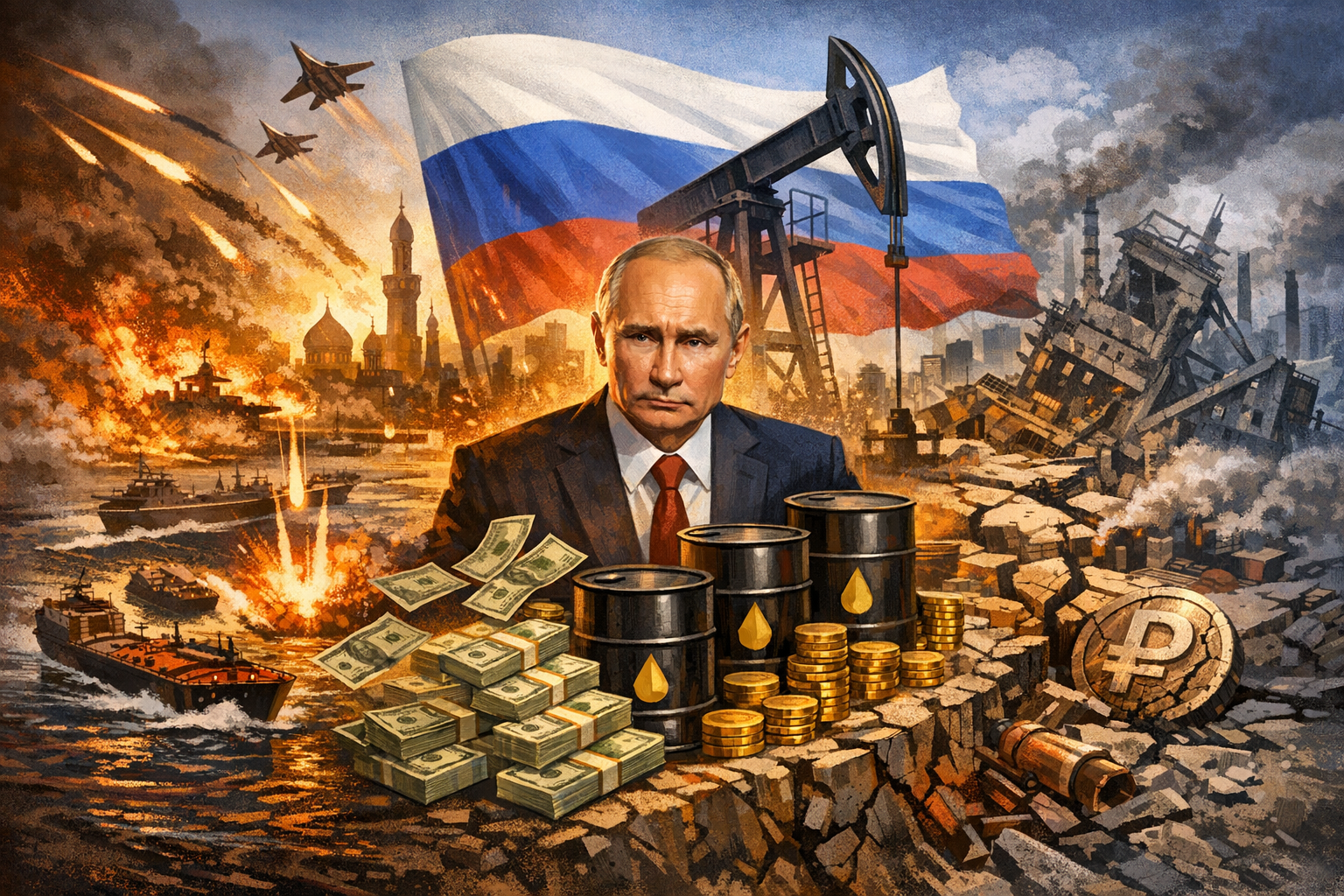
Every missile fired near the Strait of Hormuz pushes oil prices higher — and fills the Kremlin's treasury faster. The conflict involving the United States, Israel, and Iran has triggered one of the most significant redirections of global energy flows since the 2022 sanctions wave, and Russia, already accustomed to selling crude at a discount to willing buyers, finds itself positioned to absorb demand that nervous markets can no longer source from the Persian Gulf. According to Reuters estimates, Moscow's oil revenues could reach approximately $9 billion in April alone — roughly double recent monthly figures — translating to over $760 million per day.
Why Disruption in the Gulf Rewards Moscow
The Strait of Hormuz is the world's most consequential oil chokepoint. Roughly 20 percent of global petroleum trade passes through it. When Iran signals — or acts on — threats to close or contest that passage, insurance costs spike, tanker owners reroute, and buyers who depend on Gulf crude start making urgent calls to alternative suppliers. Russia has spent the past two years building exactly the kind of alternative sales infrastructure — shadow fleets, redirected pipelines, bilateral deals with India and China — that makes it capable of absorbing that demand quickly.
The mechanism is straightforward: tightening supply from the Gulf raises the global benchmark price, which benefits every producer outside the conflict zone. Russia sells at a discount to market price, but when the market price climbs past $100 per barrel, even a heavily discounted Russian barrel generates substantial revenue. The math favors Moscow regardless of where it sits diplomatically in the conflict.
A Windfall Built on Unstable Ground
The revenue surge is real. The structural conditions sustaining it are not. Russia entered 2024 carrying a growing budget deficit, having committed to military expenditures that dwarf anything its pre-war fiscal framework anticipated. Higher oil revenues provide breathing room, but they do not resolve the underlying imbalance between what the Kremlin spends and what it collects.
Ukraine's sustained strikes on Russian energy infrastructure compound the problem. Refineries, fuel depots, and export terminals have been targeted repeatedly, and while Russia has managed to keep crude exports flowing, the damage to downstream processing capacity is cumulative. Selling more crude abroad is valuable; selling refined products at higher margins is more valuable still, and that capacity is being methodically degraded.
There is also the question of duration. Oil price spikes driven by geopolitical fear tend to be self-correcting — either the conflict stabilizes, alternative supplies emerge, or demand destruction sets in as consumers and industries adapt to higher costs. A sustained price above $100 is a genuine possibility, but it requires the conflict to remain active and disruptive, which carries its own unpredictable risks for every party involved, Russia included.
The Broader Reshaping of Energy Markets
What the current crisis illustrates, beyond Russia's immediate gains, is how deeply fragile the architecture of global energy supply has become. The post-Cold War assumption — that markets would self-regulate and geopolitical risk would remain manageable — has been tested repeatedly since 2022 and is now under severe strain. Multiple conflict zones, each capable of disrupting a different node of the global supply chain, are active simultaneously.
For energy-importing economies in Europe and Asia, the picture is uncomfortable. Europe spent considerable political and economic capital reducing its dependence on Russian gas after 2022. It now faces higher oil prices driven by a conflict it has limited influence over, while simultaneously managing the inflationary consequences of sustained military support for Ukraine. Asian importers, particularly India and China, have benefited from discounted Russian crude, but a prolonged price surge narrows those discounts and raises their overall import bills regardless.
Russia's position in this environment is strong in the short term and fragile in the medium term — a combination that has characterized its economic posture since the invasion of Ukraine began. The Kremlin has proven more resilient than many Western analysts predicted. It has also accumulated structural vulnerabilities that a sudden peace, a prolonged oil price decline, or an accelerating infrastructure collapse could expose rapidly. Whether the current windfall represents a genuine strengthening of Russia's war economy or a temporary acceleration toward a harder reckoning remains, for now, an open question.